Better digital government services start with one resident login


Most residents want to handle government business online: 78.5% of residents completed at least one state or local government transaction online in the past 18 months. But agency leaders say only about half of their transactions happen online, and the experience is often what holds residents back. More than a third have started a government task online and had to finish it offline, most often because the service was too confusing.
For agencies, that’s a clear signal: every task finished offline lands on staff and delays revenue. With one secure login across agencies, residents get a “you know me” experience. Their account remembers who they are, what they’ve completed, and what’s coming up next.
What is a single resident profile?
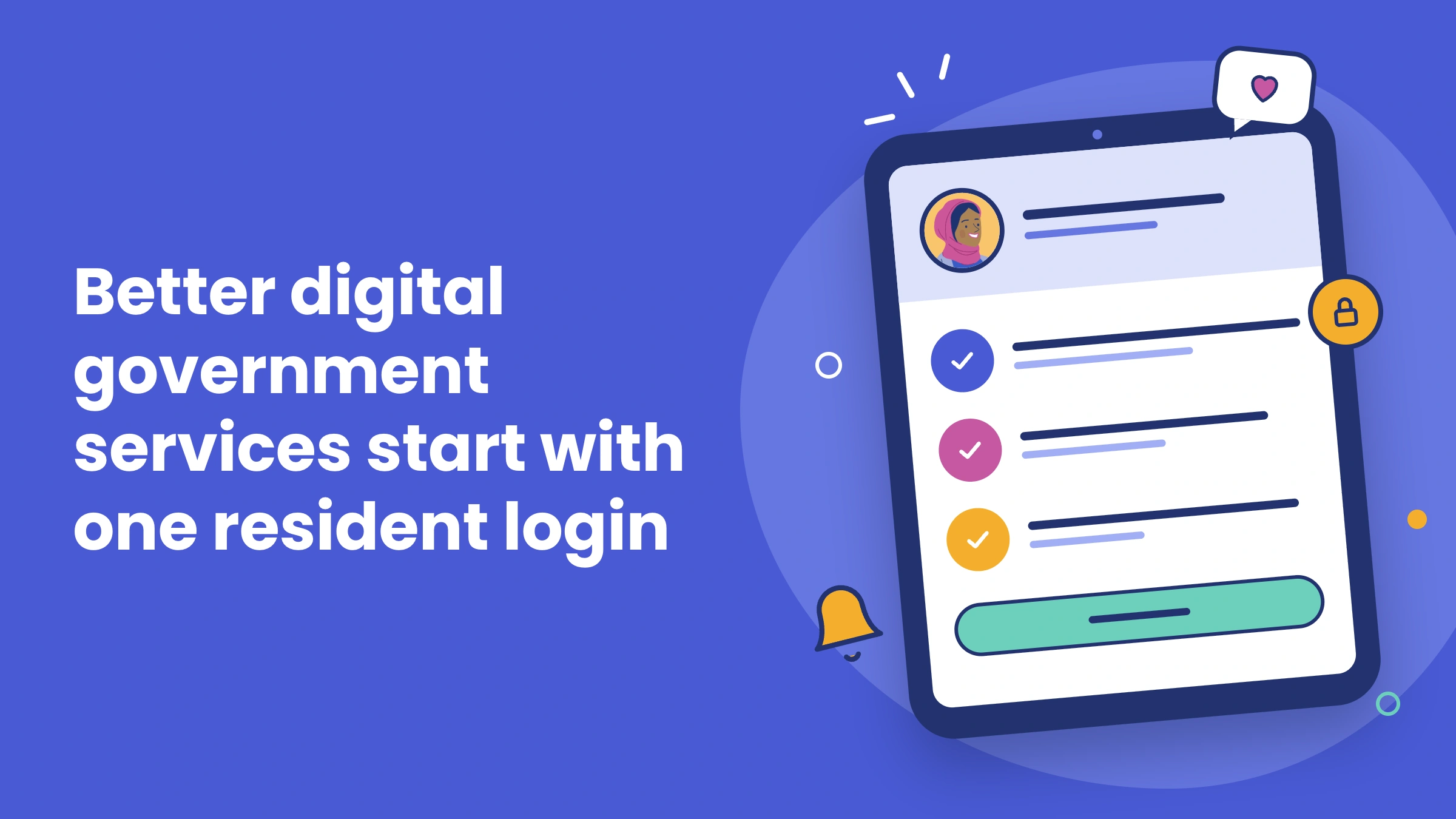
A single resident profile is one secure account, with one login, that works across government agencies and services on the same platform. Residents can see their transaction history, receipts, documents, and upcoming bills in one place, and pay with a saved payment method instead of re-entering it for each transaction.
Compare that to what most residents deal with today: a separate portal, login, and payment form for every agency or department. A single resident profile brings all of those into one account.
A single resident profile also doesn’t require one central government database. Each agency keeps its own system of record and owns its own data, while integrations connect the profile to those systems behind the scenes. And because the profile isn’t tied to one office, it can move with residents across agencies, municipalities, and states.
Why do fragmented experiences push residents offline?
Every new login and blank form is another chance for a resident to give up. Of the residents who started a task online and finished it offline, half said the service was too confusing. Repetition adds to the frustration: 60% of people say government agencies ask for the same information again and again. And with only 58% of agencies offering account profiles, roughly 4 in 10 leave residents to start from scratch with every transaction.
Trust plays a role, too. Data security is the top reason residents give for choosing an offline channel: 16.6% of residents whose last transaction was offline cited security concerns. Separate portals make that harder to solve. When a resident clicks “pay” and lands on a third-party page with a different look and web address, it’s harder to tell a legitimate page from a fake one. One account under the agency’s name gives residents fewer reasons to second-guess where they are.
What offline transactions cost agencies
When a resident finishes a task offline, the work shifts to agency staff, who answer the call, take the payment at the counter, or process the check that arrives in the mail. One city treasurer, whose office saw walk-in visits drop 75%, told Forrester that a walk-in customer “is the most expensive transaction you have.”
The reverse is also true: as more residents serve themselves, staff have more time for complex cases. In Beaufort County, South Carolina, Treasurer Maria Walls estimated that one year of online transactions equaled the work of two full-time employees working 20 days a month, nonstop.
What a single resident profile enables
Residents are already asking for one. According to PayIt’s 2026 Consumer Digital Government Adoption Index, one place to pay for multiple government transactions is the top reason residents would create an account (45.9%), followed by a secure profile with transaction history, documents, and receipts (20.3%).
| Measure | Separate agency portals | Single resident profile |
|---|---|---|
| Sign-in | A new account and password for every agency | One login across agencies |
| Checkout | One bill at a time | Multiple bills in one checkout (the top reason residents would create an account) |
| Applications and renewals | Blank forms that ask for the same details every time | Forms pre-fill from the resident’s account, and errors are flagged before submit |
| Reminders | Paper notices that cost about $0.70 each to send, or none at all | Email and text reminders (52% of residents received digital reminders and found them helpful, and another 20.4% want them) |
| Records | Receipts scattered across portals and inboxes | History, documents, and receipts in one secure place (the second most popular reason to create an account) |
| Support | Calls and walk-ins for help | During tax season, 97% of Beaufort County residents paid without contacting customer support |
What it looks like in practice
Faster applications and payments: When the platform already knows who a resident is, forms don’t have to start blank. Smart workflows use a resident’s account data to fill in fields, recommend the next step, and flag missing or incorrect information before they hit submit.
Reminders that prevent late fees: A profile knows what’s due and when, so residents get a nudge before a deadline instead of a late notice after it. In Grand Rapids, Michigan, electronic reminders helped residents avoid about $200,000 a year in water late fees. Residents engage with these messages, too: when North Carolina’s DMV emailed myNCDMV users about changes, the message had a 58% open rate, about four times its previous average.
Every service in one place: Residents don’t always know which office handles which service. With one profile, a resident paying a water bill can find trash service or their property tax bill without starting over. In Anoka County, Minnesota, an AI-powered search tool helped residents find the right service and cut support inquiries by 30% in its first quarter.
A better first impression: A resident’s first digital interaction with an agency usually starts with a login. Getting that right pays off. Every 1-point increase in satisfaction with federal services lifts trust in those agencies by up to 2 points.
How does a single resident profile connect to existing systems?
Identity remains a top priority for state technology leaders. State CIOs rank identity and access management #7 on their list of 2026 policy priorities and #4 among technologies. Connecting services across agencies raises a few common questions:
“Do we have to share our data with other agencies?” No. APIs act as the bridge between back-end systems of record, residents, and other agencies, so each agency keeps ownership of its own data. The resident sees everything in one place, and your agency only sees what belongs to you. Before you connect services across jurisdictions, review your state’s data-sharing agreements and privacy statutes.
“Do we have to replace our legacy systems?” No. Integrating with legacy systems is the #1 barrier agency leaders cite to modernizing the resident experience, but a better experience doesn’t have to wait for a full system replacement. Through APIs, a resident profile connects to the systems an agency already runs, pulling in bills and records and sending payments and updates back.
“Is it secure?” Security is a top concern for agencies and residents alike: 45% of agency leaders call data security and payments compliance their top challenge. Look for a partner that encrypts data, maintains PCI compliance, and offers multi-factor authentication through identity and access management.
“Will residents trust one account?” Security concerns are the top reason residents choose offline channels, but that doesn’t mean they’re against sharing information. 75% of people are comfortable sharing data with government in exchange for personalized services. What residents want is to know their information is safe, and a secure profile that shows their history, documents, and receipts in one place helps build that confidence.
Where is it already working?
In Kansas, residents use one account across state agencies and counties, and in North Carolina, millions of residents use one account for a growing list of services.
Kansas: Since 2018, iKan has brought state and county services together in one app, from driver’s license and vehicle registration renewals to vital records and property taxes. Nearly 50% of Kansas residents have created an account, and the platform has collected more than $1.3 billion online.
North Carolina: myNCDMV has 7.6 million users, and 3 out of 4 North Carolina drivers use it. Residents have completed more than 25 million transactions, and the state has since added services like voter registration and disability placard renewals to the same account.
When a new agency or county joins a platform residents already use, many residents can sign in with the account they already have.
A better front door for digital government
Residents don’t think in terms of agency departments, they think about what they need to get done — renew a registration, pay a tax bill, or apply for a permit. A single resident profile meets them there.
For agencies, the single resident profile pays off with every service added to it. Each new application, renewal, or payment starts with residents who are already signed in, trust the experience, and are more likely to finish their task online. That means revenue that arrives faster and less need for customer support.
Learn more about what residents expect from digital government in PayIt’s 2026 Consumer Digital Government Adoption Index.
You might also like
Useful GovTech insights — right in your inbox
Get articles and insights from our monthly newsletter.