
How to choose the best government payments and customer experience software
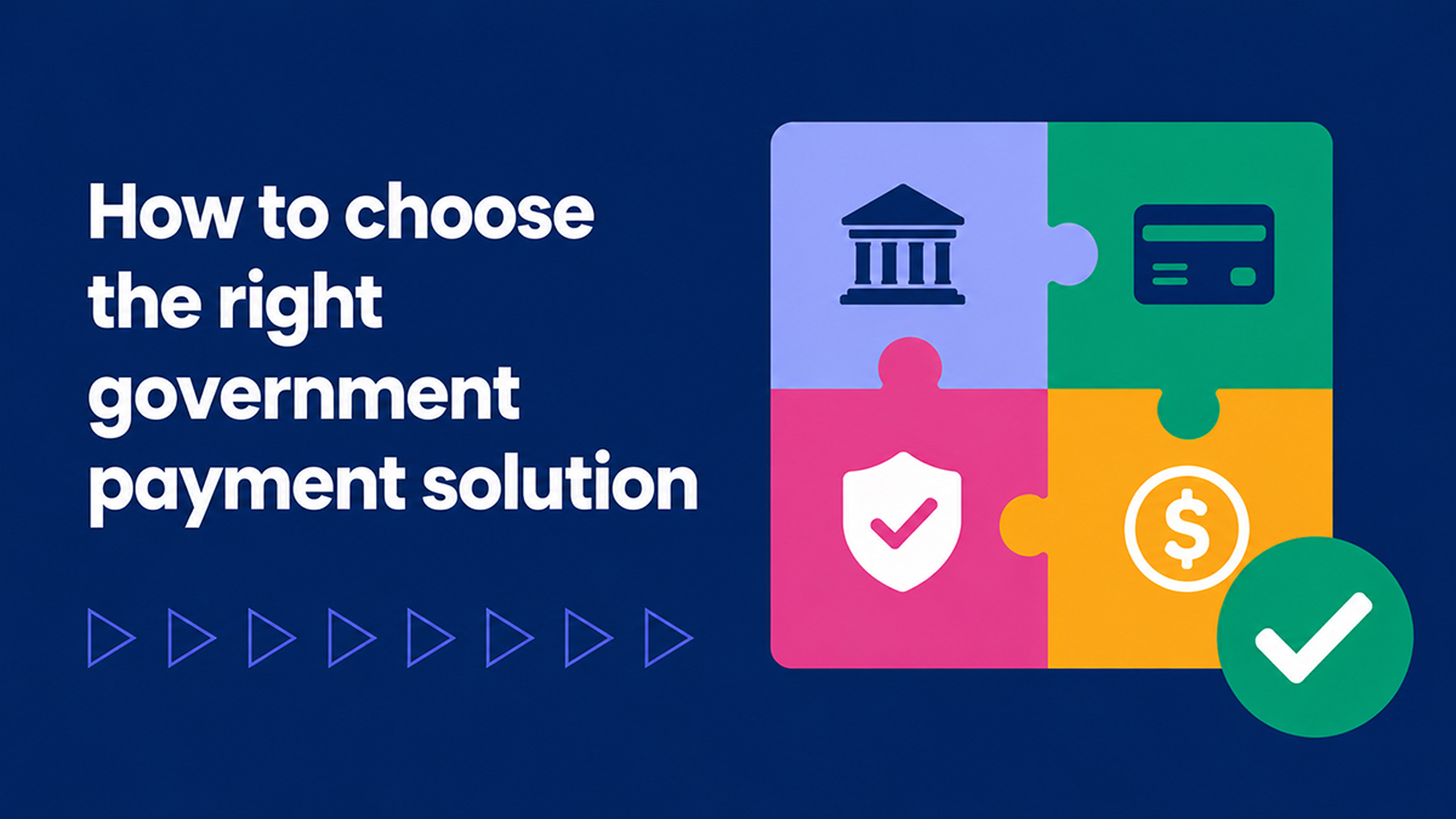


Finance directors, IT directors, and department heads evaluating new government payment solutions often start in the same place: a payment page that needs replacing before a contract runs out. Under that kind of deadline, it’s tempting to pick whichever vendor looks closest to what you already have, or even keep the same one. But more of the same may not be the right thing for your residents or your agency.
This quick guide covers what matters when evaluating government payment vendors — specifically, what makes a vendor a partner, the technical questions IT should be asking about APIs and legacy integration, what finance should press on for reconciliation and reporting, and how to tell a vendor’s live AI features from features still sitting on a roadmap.
Modernize government services without replacing your core systems
Modernizing resident-facing services doesn’t require a large, centralized overhaul. PayIt’s 2026 Government Payments Experience Index, a survey of 600 state and local government leaders, found that modernization today is less about rebuilding from the ground up and more about reducing friction step by step.
Two key actions that matter when modernizing digital government services:
- Identify a champion with the authority to make purchase decisions or real influence over budget allocations. That might be a deputy CIO, a director of digital services, or a treasurer.
- Pick one or two high-impact use cases instead of trying to digitize everything at once. Property tax payments and utility billing are common starting points because they’re high-volume, recurring, and often still paper-heavy. Starting narrow simplifies the integrations you need and the change management required to launch.
What to look for in a government software partner
Plenty of companies will sell you government payment solutions, but few will act like a partner that can help you meet your goals.
Expect your government payments and customer experience software vendor to effectively answer questions like:
- Is the platform designed for public sector? Government agencies operate under legislative and regulatory constraints that industry-agnostic vendors often don’t understand, and you don’t have time to educate them on the job. A strong response highlights a platform built specifically for public sector needs, or references actual government clients and details an account management team committed to public sector customers.
- Does the vendor have a plan to help you market new digital services and drive adoption? A strong answer includes real tactics, a stated adoption target, and a track record of hitting it with other agencies.
How the vendor gets paid matters too. Per-transaction pricing models mean the vendor doesn’t collect revenue until the solution is live, which gives them real motivation to launch your solution quickly and help you drive adoption. Flat subscription or large project-based pricing doesn’t create the same incentive, especially over a long contract term.
Evaluate the resident experience before and after payment
A standalone payment page doesn’t help residents find the right service, understand what they owe, or get a receipt they can find again later. Treating payment as an isolated step only solves for revenue capture and reporting; if residents can’t see that their payment is confirmed, they’re more likely to call or visit your office. PayIt’s Consumer Digital Government Adoption Index captures this experience, finding that one in five residents say the government payment process is slower and less intuitive than a comparable private-sector transaction.
Ask to go through a live implementation yourself, and pay attention to what happens before and after payment. Notice how receipts and transaction history are stored, whether autopay and installment plans are configurable, and how disputes get resolved.
What IT should ask payment platform vendors
How does the vendor’s platform handle configuration (and reconfiguration)?
Custom-built government software is expensive to update, and slow to change. Ask the vendor how they make updates and changes as your needs shift. If the answer involves deploying their engineers every time, keep looking.
How does the vendor handle integrations?
Some vendors limit integrations to a small set of favored partners and charge for anything outside that list. You own your data, so you should make sure your vendor’s architecture reflects that. Open APIs let you move your own data across systems without being locked in. Ask for references from clients where the vendor integrated with systems that are 20-plus years old.
What finance and business leads should ask payment platform vendors
Does the vendor consolidate data from disparate systems and sources?
Manual reconciliation is one of the biggest hidden costs in a disconnected payment system. Ask whether the platform consolidates data from spreadsheets, processors, and internal records automatically, or whether your team will still be manually matching numbers across systems.
How does the vendor’s platform affect delinquency and transaction settlement speed?
A more intuitive resident experience means more completed payments on the first try, and payment reminders can meaningfully reduce late payments. Ask the vendor about these features, and any data they have on reducing delinquency or accelerating settlement.
Security and compliance can’t be an afterthought
Any time your agency touches payment credentials, you take on PCI compliance obligations. A strong partner takes on as much of that burden as possible, but it’s still a shared responsibility. Get specific about where the vendor’s responsibility ends and yours begins.
At minimum, look for tokenization of payment credentials, encryption both in transit and at rest using AES 256 or the standard set by NIST Special Publication 800-131A Revision 2, and hosting on a government-grade cloud platform such as AWS GovCloud, Microsoft Azure Government, or Google Assured Workloads. Ask about their compliance with PCI-DSS Level 1, SOC 2 Type II, and ISO 27001, and whether they run both automated monitoring and human incident review. If a vendor can’t speak clearly to these standards, that’s a disqualifying answer.
Evaluating AI features in government software
AI passed cybersecurity as the top priority on the 2026 NASCIO State CIO Top Ten list, and most vendors are integrating AI into their platforms to meet the demand. What matters is whether AI features are live or still on a vendor’s roadmap.
Ask vendors to show you AI features that are available today, who’s using them, and what results they’ve measured. Then ask how they govern those features. Can they explain in plain language how a given output is produced, have they tested for biased outcomes across demographic groups, and are there real checkpoints where staff can review or override an AI-generated decision? A vendor pushing you toward capabilities faster than your agency’s policy framework or staff readiness can support is not a vendor whose incentives match yours.
Check references properly
Don’t stop at the references a vendor hands you. Use your own network to find other agencies running the platform.


Useful GovTech insights — right in your inbox
Get articles and insights from our monthly newsletter.