$1 billion collected online: Grand Rapids’ replicable government finance modernization playbook
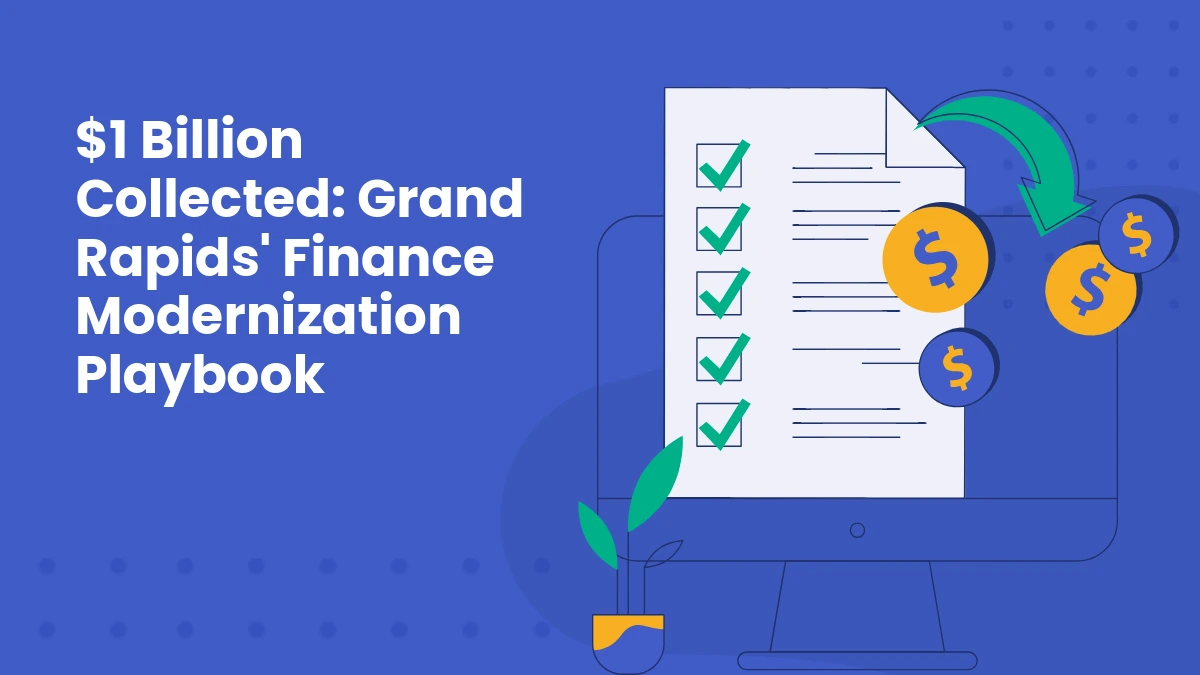


With nearly a decade of data in hand, Grand Rapids City Treasurer John Globensky took the stage at GFOA’s 120th Annual Conference to share the impact of a full commitment to digital transformation.
Grand Rapids, Michigan launched its digital payments platform, GR PayIt, in 2017. Since then, the city has cut walk-in traffic at City Hall by 65%, collected more than $1 billion through the platform. Online collections have grown 491% (from $29.6 million in 2017 to $175.2 million in 2025). In December 2025, the city’s work earned a GFOA Award for Excellence in Government Finance.

Government finance leaders from around North America joined Globensky’s GFOA session to understand how the city achieved these results, and how they can use lessons from Grand Rapids to drive payment modernization and digital adoption in their own communities.
The challenge: Fragmented systems, frustrated residents
Before 2017, Grand Rapids residents dealt with long lines and wait times at City Hall. They also used a separate login for every city service, and payment options were inflexible or inaccessible.
On the back end, staff faced complex, redundant reconciliation processes across multiple disconnected payment processors. Taxes, water, refuse, and parking each ran through a different system.
The results were less than desirable for the resident and agency staff alike. Only 53% of payments were collected electronically in 2016. And 86% of the city’s web traffic was residents searching for a way to pay a bill or ask a payment question.
The vision: One login across multiple government services
Globensky and the Grand Rapids team sought out a partner that went beyond payment processing. The goal was to create a “digital front door” for residents: one unified login for every city service, payments accessible from any device, and a deliberate decision to reduce friction by absorbing costs, adding bilingual accessibility, and improving the mobile experience.
For city staff, the goal was to simplify back-end reconciliation, reduce support calls and City Hall lines, and cut down paper and postage usage.
To realize this vision, Grand Rapids partnered with PayIt to launch GR PayIt. The platform consolidates property tax, water payments, refuse, and parking tickets under a single, user-friendly profile. Features like eBilling, bill notifications, AutoPay, scheduled payments, and saved payment methods make it easy for residents to pay quickly and on time. That means Grand Rapids collects more revenue, faster.
How investing in a digital front door paid off
Since launching GR PayIt in 2017, Grand Rapids residents and staff have both seen significant outcomes:
- 491% increase in dollars collected
- 142% increase in electronic transactions
- 65% reduction in walk-in customers at City Hall
- 90% resident approval rating in the city’s biennial satisfaction survey
- 85% of payments now collected electronically, up from 53% in 2016
- 84% on-time payment rate for utilities, which cut late fees by about $200,000 a year
- 98% transaction success rate on the platform
- Reconciliation time cut from days to minutes
The city expects to collect an estimated $200 million through the platform in 2026. Residents save more than $500,000 a year on checks, postage, and envelopes, and the city eliminates 39.9 tons of paper annually.
How other agencies can replicate Grand Rapids’ success
In his presentation, Globensky emphasized that the success of GR PayIt can be replicated in other jurisdictions. That holds true regardless of size or existing systems.
Globensky closed the session sharing these “replicable success factors” for agencies looking to modernize:
- Focus on customer experience from the start. Grand Rapids focused on the transactions residents encounter most: property tax, water, refuse, and parking. Beyond that, Globensky’s team emphasized the importance of accessibility, ensuring the platform is mobile-friendly and easy to use.
- Invest in marketing, because your government is a brand. Globensky argues government has to build a brand the same way any consumer service does. Staff should be trained to think like digital marketers. Grand Rapids ran bus advertising (a $30,000 investment that generated an estimated 30 million views), sent direct mail to more than 200,000 residents, participated in community festivals, and ran a “Go Green” sustainability campaign.
- Enable residents to shape the experience. More than 1,600 community members tested GR PayIt during the pre-launch phase. Focus groups surfaced usability issues that were addressed before the broader rollout. The city also refined its chatbot based on real user feedback at launch.
- Launch with high-volume services first. Grand Rapids launched with the services that made up 90% of resident payments. That gave the platform scale and visibility from day one, instead of starting with smaller, lower-traffic use cases.
- Measure everything and survey customers often. Grand Rapids runs a biennial customer satisfaction survey and tracks adoption by channel continuously. That data is what lets the city identify areas of improvement, ensuring the digital front door is delivering on the goals Grand Rapids set out to achieve.
What’s next for Grand Rapids
Because GR PayIt is built on PayIt’s configurable platform, Grand Rapids is able to easily add new features and services. The city has recently rolled out AI-powered service discovery capabilities to help residents quickly find the services they are searching for.
The city’s next priorities include delinquent personal property tax collection, integration with court systems to reduce hearings, digital wallet expansion (including Venmo), and deeper cross-departmental data integration and analytics.
Grand Rapids has partnered with PayIt since GR PayIt launched in 2017. See how the partnership has evolved, or talk to a PayIt specialist about what a similar approach could look like for your agency.
You might also like

Useful GovTech insights — right in your inbox
Get articles and insights from our monthly newsletter.