The 2026 Government Payments Experience Index
Modernization Gains Momentum Despite Legacy Challenges

Download the PDF version for the full report with visual representations of data.
Modernization enters its AI era
State and local government agencies continue to be tasked with doing more with less. In the pursuit of continued efficiency gains, modern digital payment platforms and emerging technology like AI are helping overcome constraints and reshaping what’s possible.
Although legacy systems remain part of the operational landscape, they no longer have to dictate the pace of progress. Public sector leaders recognize that strategic investments — particularly in front-end user interface platforms and AI — can integrate with existing infrastructure, streamline financial operations, and create cleaner data pathways that support immediate efficiency gains, a better resident experience, and long-term innovation.
Modernization, in this context, is less about rebuilding from the ground up and more about reducing friction step by step.
Our study of 600 leaders from state and local government reveals how their organizations are charting a path to faster modernization, even as they continue to contend with dated systems of record and slow-moving processes.
Key ideas shaping digital government services:
- Great user experiences underpin the shift to digital. As more agencies offer online payments, the focus of digital services shifts from basic availability to driving adoption.
- Integration with legacy systems remains a defining challenge. Citing dated backend systems as the top barrier to payments modernization, leaders are increasingly seeking workarounds and better data integration to speed the path to digital government.
- Modern payments tech exposes security challenges in older systems. As government organizations upgrade resident payments, compliance and security concerns continue to weigh heavily.
- AI helps speed modernization but use cases remain narrow. Optimism about AI’s potential is paired with caution, resulting in a thoughtful rollout of the technology, starting with back-office and internal use cases.
This year’s findings depict state and local governments in a moment of transition — from barebones digital options to an optimized digital experience. With basic online services widely established, the focus is shifting to improved usability, growing use of digital channels, and ensuring back-end systems can support rising demand and emerging technologies. Leaders are increasingly focused on identifying ways to deliver a better experience within the constraints of their existing systems of record — and looking to AI to help close the gap.
Digital experiences are improving, but widespread adoption lags
Although some organizations are still working to digitize transactions and drive channel shift, 78% of state and local leaders we surveyed reported that their agency already accepts online payments for at least one fee or service, and the remainder of respondents plan to accept digital payments in the near future.
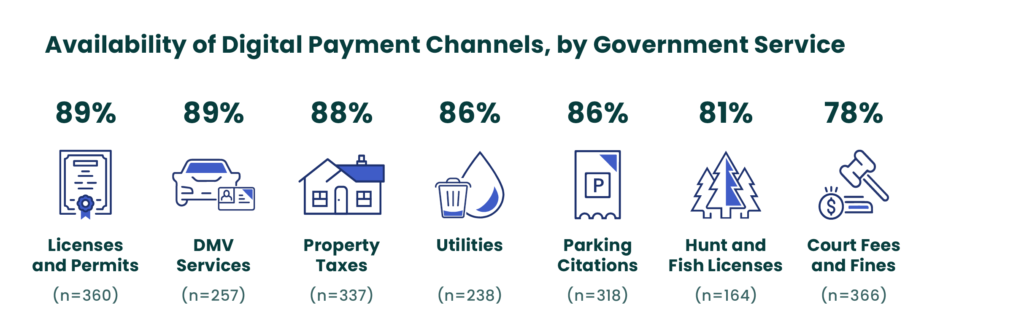
Most agencies already offer online payments, and the remainder of our respondents plan to add a digital channel in the next 18 months. DMV and licensing/permitting have the highest acceptance rate for online payments at 89%.
In their own words: Respondents on their ideal user experience
We asked respondents to describe their ideal customer experience for resident payments and how AI is helping them deliver better efficiency and outcomes. Here are some representative responses.
The overarching goal is a frictionless, inclusive resident experience
“The interface should be intuitive, the payment process simple, ensuring residents with varying levels of digital literacy can use it smoothly.” ~ State IT Leader
“Mobile-first design allows residents to complete tasks anytime, anywhere, reducing the number of times they need to go to the office.” ~ State IT Leader
“24/7 AI-powered chatbot language self-service would be nice, so residents have access to information about bill inquiries and payments.” ~ State IT Leader
Online payment offerings are gradually becoming more feature-rich. Credit/debit cards and ACH payments are commonly accepted, and capabilities like auto-pay, payment reminders, and flexible payment plans are increasingly supported.
Even payment options that were previously wish-list items now have a high acceptance rate among the public sector leaders we surveyed. Eighty percent accept Apple Pay, 75% accept Google Pay, and 70% accept peer-to-peer payment methods such as Zelle, Venmo, and PayPal.
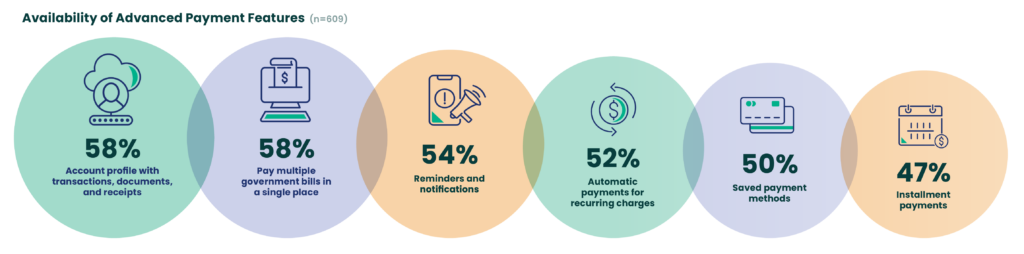
Even as digital payment offerings improve, leaders in government organizations know that they need to shift more users online to see transformational efficiency gains.
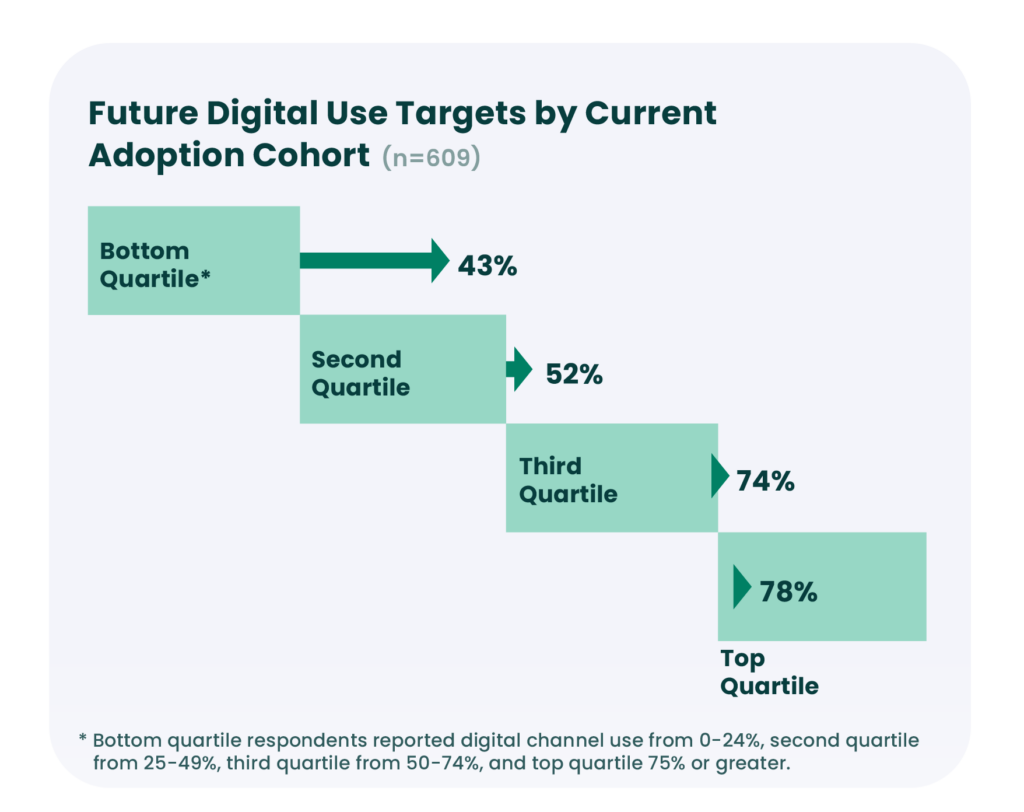
Today, the average rate of digital payment adoption among our respondents is 49.5% — meaning more than half of transactions still rely on higher-cost, manual channels. Looking ahead, respondents are targeting an average increase in digital use of 13.8 percentage points.
Government organizations of every size reported efforts to increase digital channel use, but the degree of ambition is shaped by the starting point.
Notably, operational leaders and elected/appointed officials have different perspectives on growing online adoption. IT and line-of-business leaders have targeted 15 points of growth in digital channel use; elected and appointed officials demonstrate much less ambition — only 4 points. (One hypothesis: Those closest to operational friction are the most urgent about change.)
As such, the focus has shifted to improving the experience and promoting digital services — availability must be matched with frictionless navigation for residents to truly embrace digital services.
Agencies recognize that resident digital experience fosters wider adoption: Improved ease of use was most frequently cited as having the most potential to increase resident adoption (34%), alongside increased promotion of digital services (25%) and expanding available payment methods (21%). Offering a barebones digital channel is not enough to hit adoption targets.
Having largely solved for “Can residents pay online,” government leaders are now focused on pushing the payments experience toward user adoption, data consolidation, and operational optimization.
In their own words: Respondents on their ideal user experience
Government leaders have a clear vision for what that experience should look like
“Real-time status updates for every payment and permit application submitted.” ~ Municipal Line-of-Business Leader
“It can achieve one-person-one-file, and track the work progress in real time.” ~ Municipal Line-of-Business Leader
“Centralized system where all government fees and permits are available in one place, along with clear information and step-by-step guidance on how to complete the payment.” ~ County Line-of-Business Leader
“To serve all residents equally, accessibility features… including language assistance and ADA compliance.” ~ Municipal IT Leader
Payments are an operational stress test for modernization
Aging IT systems, often built decades ago, struggle to keep up with today’s demands for agility, scope, and security — on top of that, they’re getting more expensive and challenging to maintain.
We asked public sector leaders about what holds them back, and integration with older systems was cited most frequently as the top barrier to modernizing the resident-facing digital experience in their organization. Leaders working in mid- and larger-sized jurisdictions feel this pain most; they were even more likely to cite integration with older systems as the top barrier.
Respondents noted that a variety of implications, ranging from manual reconciliation costs and audit risk exposure to increased dependency on middleware and staff workarounds, all hinge on legacy IT integrations.
Financial operations are typically the first place modernization gaps surface. Amid high transaction volume, multi-system handoffs, and regulatory requirements, payment processing exposes legacy issues faster than other services. Indeed, one-quarter of respondents cited financial operations as their biggest challenge in payment collection and processing. And public sector leaders from areas with 1 million to 5 million residents cited financial operations as the top challenge more often — 38% of larger jurisdictions.
In their own words: Respondents on their ideal user experience
To unlock efficiency, the digital platform must also integrate with legacy systems and consolidated data
“Integration with back office systems syncing with tax court, permit, and ERP systems.” ~ County Line-of-Business Leader
“Comprehensive service coverage, integrating all payment options, eliminating the need to switch between multiple platforms.” ~ State IT Leader
“Unified management, intelligent search, simplified procedures, convenient work management, and time saving are important.” ~ State IT Leader
“It can automate payment reconciliation and license issuance, reducing manual operations, shortening processing time, and lowering the pressure on offline counters and the cost of paper document management.” ~ State IT leader
High transaction volumes, compliance obligations, and siloed data quickly expose inefficiencies. When payment data doesn’t flow cleanly into the system of record, finance teams are stuck with complex and error-prone reconciliation workflows — multiple spreadsheets, portals, and disconnected reports. And for many agencies, this juggling act takes place on a high wire: compliance and security risk.
Payments fragmentation amplifies security and compliance risk: 45% of our respondents said their biggest challenge in payment collection and processing is Data Security & Payments Compliance. This pain is especially pronounced with local (county, municipality, special district) respondents: 54% of local leaders cited Data Security & Payments Compliance as the top challenge, versus 36% of state respondents.
These findings underscore how fragmented payment environments create both operational inefficiency and regulatory risk.
Modernizing payments isn’t just about resident satisfaction. Speeding up and improving the accuracy of reconciliation have nudged ahead as the most frequently cited business priority for government teams, but support costs and revenue management aren’t far behind.
Government leaders are struggling with inefficient accounting and reconciliation processes caused by multiple siloed systems — and solving those problems is a driving force in how agencies choose payments technology.
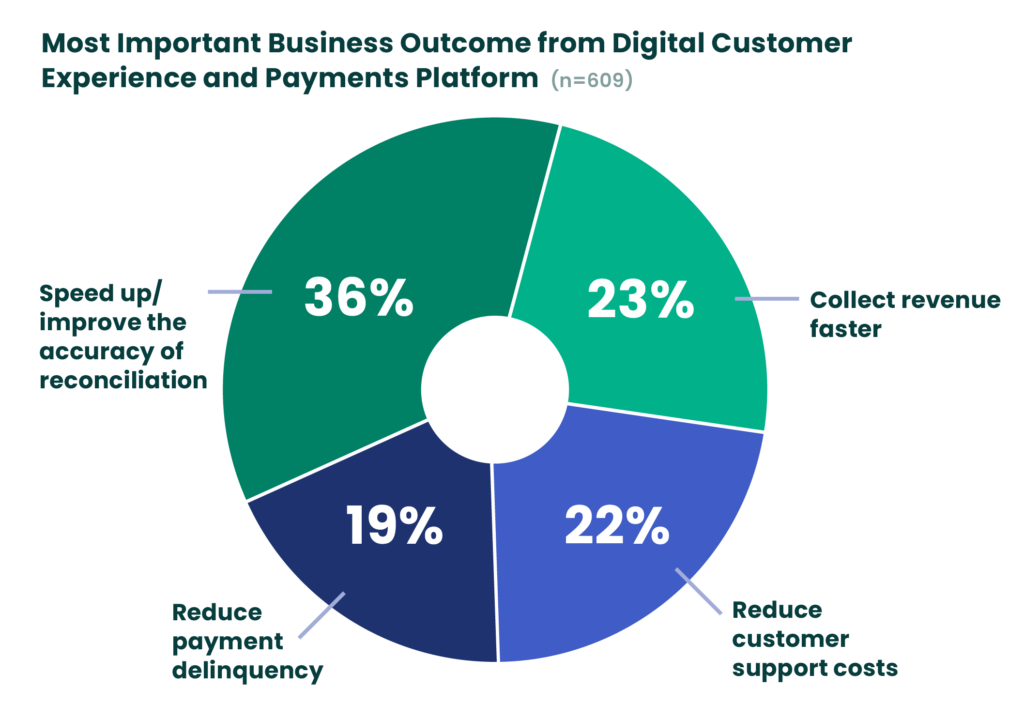
Without widespread digital adoption, consolidation of financial data, and integration to the backend, payments modernization initiatives will fail to deliver on their promise of improved operating efficiency.
AI momentum is building, but data readiness remains a limiting factor
AI adoption across state and local government is accelerating, but unevenly. A majority of agencies report using or evaluating AI, but the uses cited are largely tactical point solutions. In the back office, respondents most frequently mentioned using AI to automate processes such as data entry or invoice management, or to check for errors in reconciliation. And on the resident-facing side, agencies are adopting AI for always-on chatbot support and routing service requests.
Other studies, like the Google Public Sector survey, have similar findings. Most agencies are using AI for internal and back-office needs like document and data processing, workflow automation, and resource allocation.
Respondents are overwhelmingly positive about the impact of the AI investments they have made thus far. When asked about how their back-office AI investments have driven efficiency, 47% indicated they have seen a “very positive impact,” and another 46% agreed they have seen a “positive impact.”
With the efficiency upside now well understood, government leaders are leaning into AI enthusiastically.
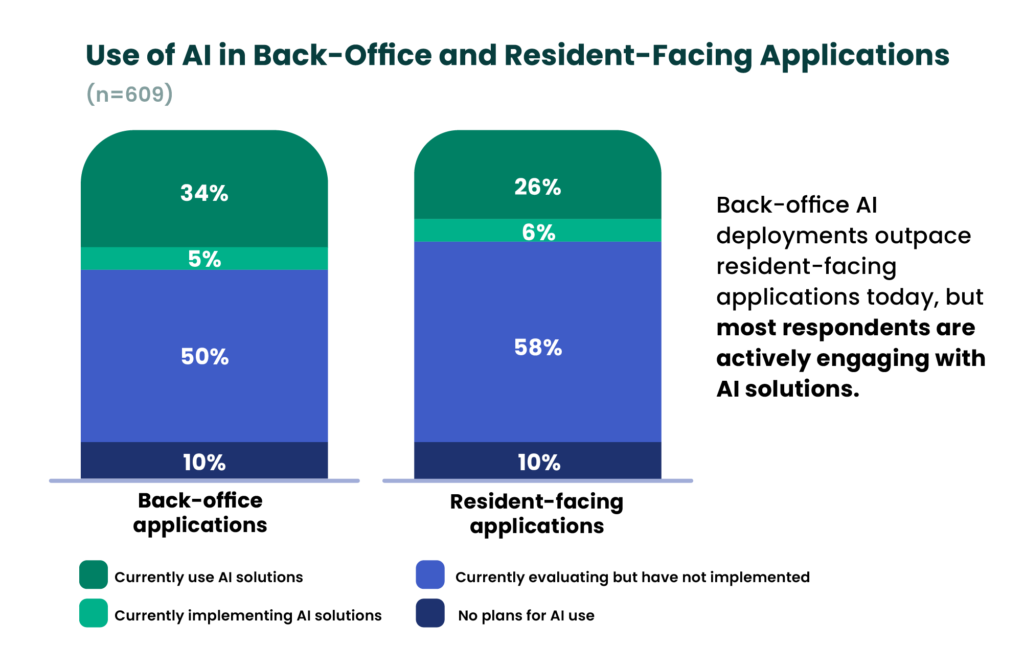
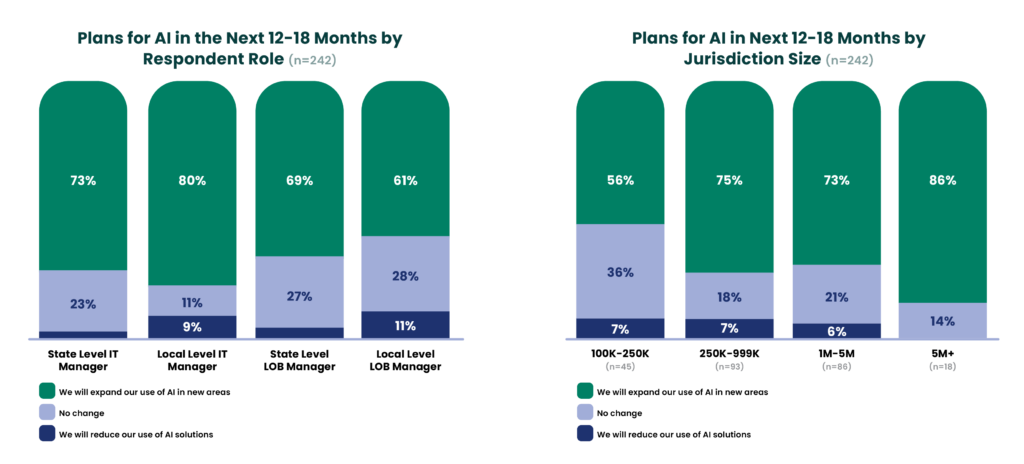
Among respondents with live AI projects, 72% expect to expand their use of AI in the next 12-18 months. In fact, only 6% said they would reduce their use of AI in the near future. While 72% of respondents overall reported expansion plans for their use of AI in the next 12-18 months, IT leaders and larger jurisdictions have higher rates of expansion plans.
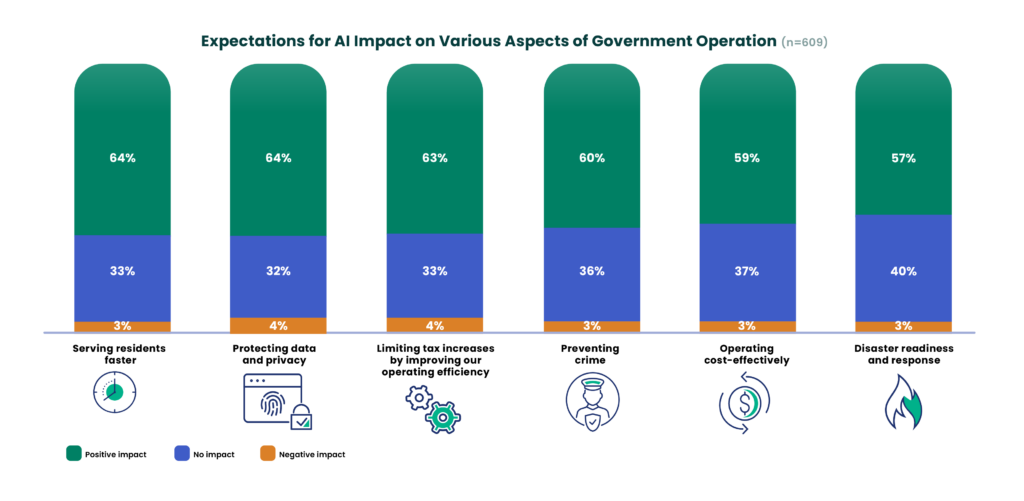
That said, government leaders understand that their AI journey is a marathon, not a sprint. While our respondents cited positive outcomes from AI, there’s also meaningful skepticism about its impact — roughly one-third of respondents expect AI will have no impact in multiple aspects of government operations.
As AI models and implementations mature, consumer comfort with and adoption of AI are still emerging. But that doesn’t mean there’s no demand for resident-facing artificial intelligence.
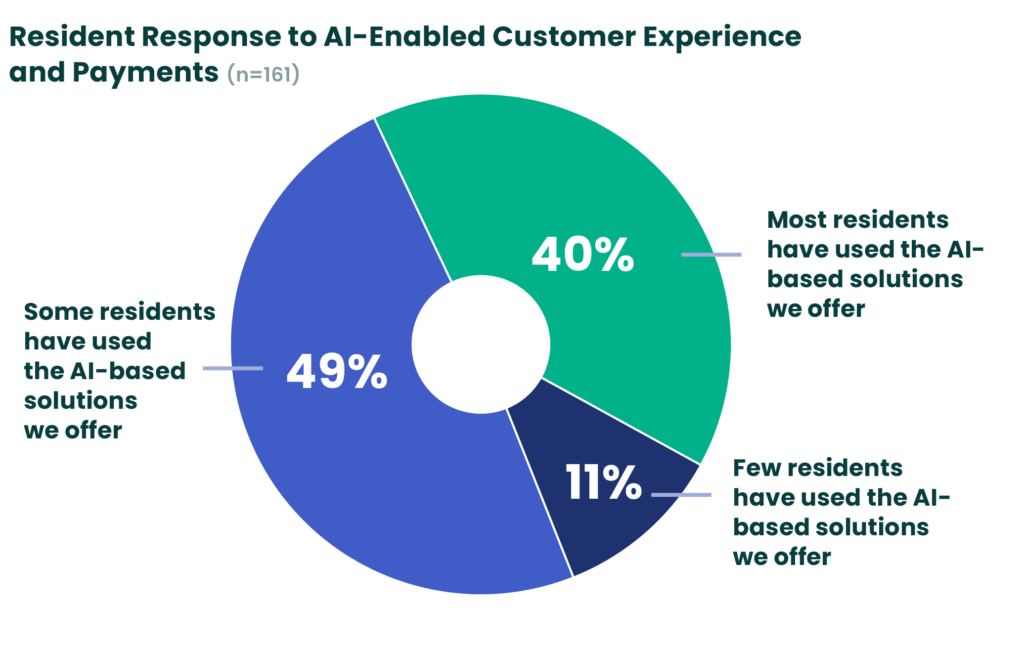
Last year, about one-third of the residents we surveyed said they never used AI for work or personal tasks, and less than half of respondents used AI more than a couple of times a year. This year, public sector leaders report that residents are using AI-powered solutions.
Despite enthusiasm and demand for AI, legacy infrastructure and data remain structural constraints, limiting how quickly AI can scale beyond pilot use. McKinsey research has found the same: Regulatory uncertainties, data and infrastructure gaps, and varying technical standards mean that progress can be confined to isolated areas.
When it comes to AI deployment in government, the USA was named an “uneven adoptor” in the Center for Data Innovation’s Public Sector AI Adoption Index 2026 — with enthusiastic leadership and education, but patchy progress. AI is present but unevenly embedded, often constrained by unclear permissions and legacy infrastructure.
Thousands of legacy back-office systems still power core government functions, from licensing to public assistance to revenue collection. These systems were built for recordkeeping — not interoperability, real-time data exchange, or advanced analytics. Looking at the next 12-18 months, the Google Public Sector survey found that legacy systems were the biggest constraint to AI adoption.
As a result, data access, consolidation, and accuracy remain persistent challenges. However, AI depends on structured, accessible, and trustworthy data. Without consolidated financial information, agencies cannot move from tactical deployments to advanced use of AI for predictive analytics, workforce planning, or optimizations driven by agentic AI automations.
To avoid a widening gap between AI’s promise and the operational realities required to fully realize it, government agencies should prioritize AI readiness projects that normalize and consolidate data, integrate systems, and identify high-leverage project areas.
In their own words: Respondents on their ideal user experience
AI-enabled automation is being used for efficiency and compliance
“I use AI tools to automate repetitive administrative tasks, which saves time and reduces manual effort.” ~ State IT leader
“AI to model different scenarios, assess risks, and evaluate potential outcomes which improves the quality and confidence of business decisions.” ~ County Line-of-Business Leader
“We use AI for automated processing and classification to achieve bill matching, anomaly detection, and real-time reconciliation — reducing human intervention.” ~ State IT Leader
“AI-powered customer service responds to residents’ inquiries and provides solutions to optimize processes and improve efficiency.” ~ State IT Leader
Aligning the government tech stack for efficiency outcomes
For years, government agencies have pushed to get services online, and they’ve been largely successful. Now, the challenge is getting those services to work harder to achieve target outcomes — and to get them working together. The lack of cohesion isn’t due to a lack of tools; it’s due to disparate systems, fragmented payments, and multiple vendors scattering data — all of which undermine agency efficiency.
Government agencies can make meaningful progress in modernization. Start here:
- Design for customer experience to drive widespread resident use, minimize support inquiries, and maximize efficiency benefits of going digital.
- Consolidate payments into a single management experience across different services and channels. And address fragmentation of payment vendors, which creates unnecessary friction in financial operations.
- Insist on integration with your system of record and other vendor systems. You own your data, and vendors should not stand in the way of your path forward.
Prepare for the next step with AI by understanding and rationalizing the data in the various systems you have in use now, so that your organization can deploy more advanced AI use cases.