ADA Title II compliance deadlines coming in April 2026
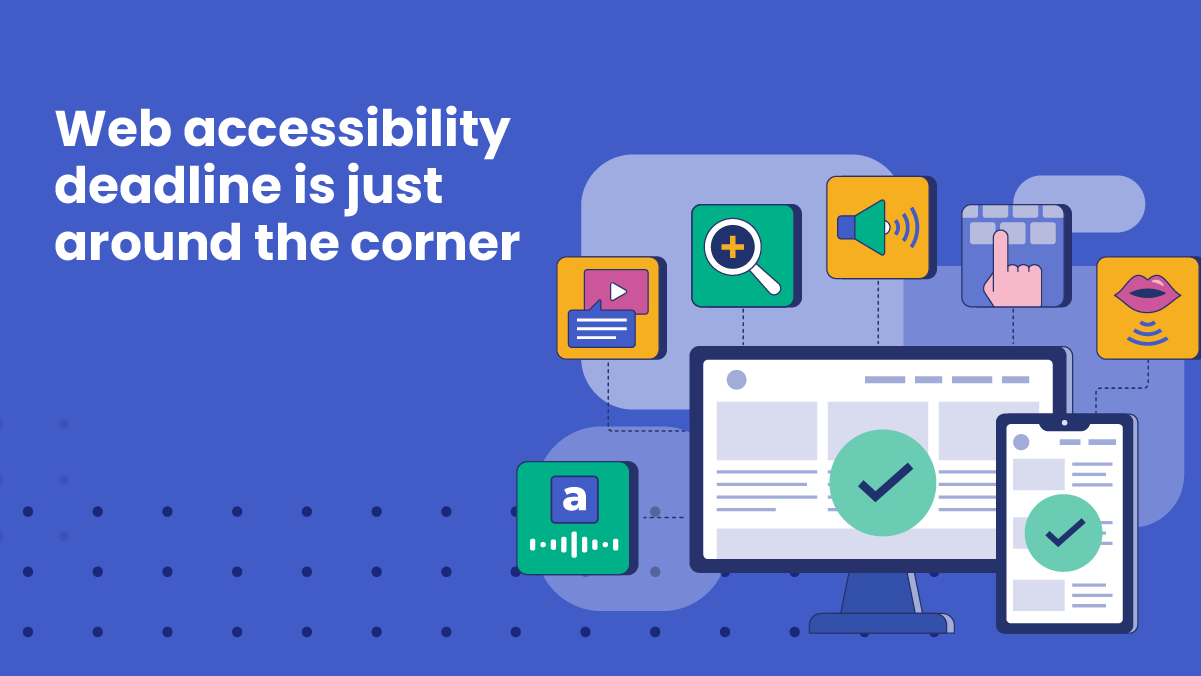


In 2024, the Department of Justice (DOJ) published a new rule, Title II, requiring all state and local governments (and third-party vendors) to comply with WCAG 2.1 A/AA standards — and that deadline is fast approaching.
By April 24, 2026, digital content produced by public entities (like state and local governments and universities) in areas with 50,000 or more people must meet the new accessibility requirements.
Previously, the Americans with Disabilities Act (ADA) did not specify technical standards for web accessibility. Compliance was often interpreted through a variety of standards and guidelines, leading to inconsistent application. However, the Title II rule has specific requirements to make sure that web content and mobile apps are accessible to people with disabilities.
The first compliance deadline is this spring.
ADA Title II compliance deadlines
- Resident population size of 50,000 or more people: April 24, 2026
- Resident population size of 0 – 49,999 people: April 26, 2027
- Special district governments: April 26, 2027
If you need a reference document as you work through your accessibility updates, the federal government previously released a resource to help agencies plan their modernization strategy.
Department of Justice’s ADA Title II resource
The DOJ resource is a helpful starting point — information that should be used in conjunction with other resources to ensure compliance with the rule. It gives general guidelines such as:
- Roles and expectations of staff
- Vendor responsibilities
- Content audit tips
- Examples of what content needs to comply and what would be exceptions
- Identifying and prioritizing fixes and updates
- Setting up for success with an internal ADA policy
The steps and tips in the resource aren’t mandatory; the guide is meant to help all government agencies accommodate residents with different types of disabilities: visual, cognitive, learning, auditory, physical, and speech.
What types of digital content need to comply?
These are just a few examples of required accessible services:
- Online payments for services, including taxes, utilities, permits
- Public records access for things like document requests and meeting agendas
- Public health and safety messaging, like emergency alerts
- Legal and judicial services, including court records, paying fees, and legal aid services
Agencies should be aware of (and ready to rectify) digital barriers as more services move to an online domain. An accessible digital environment conforms to the Web Content Accessibility Guidelines (WCAG).
Assessing web and mobile accessibility
According to the Title II rule, complying with WCAG 2.1 Level AA is required.
- WCAG version 2.1 (2018) is the most recent version of WCAG. Versions build on each other with updates as needed, so conforming to the most recent version is conformance to all versions.
- Level AA is the most common level. Though it’s considered to be the midrange level, it is the most recommended as the highest level (Level AAA) is often not applicable for digital government uses.
This information is often provided on an agency’s accessibility webpage or in its accessibility statement.
Web accessibility standards overview
The Web Content Accessibility Guidelines (WCAG) are technical guidelines for creating an inclusive online environment. While WCAG is not legislation, it is considered the global standard for web accessibility. Most digital entities conform to some level and version of WCAG.
When an agency conforms to WCAG, it automatically aligns with standards of accessibility legislation, including the Americans with Disabilities Act (ADA), Section 508 of the Rehabilitation Act of 1973, and Accessibility for Ontarians with Disabilities Act (AODA), to name a few.
Conforming to WCAG implies that a digital entity follows its four principles: perceivable, operable, understandable, and robust. While there are precise instructions under each overarching category, the four summarizing principles act as a guide for creating accessible websites and apps.
What exactly does it mean for a digital entity to be perceivable, operable, understandable, and robust?
- A perceivable website’s information is displayed in a way that all residents can perceive and be aware of — i.e., information is “perceivable” through sight, touch, and hearing.
- On an operable website, a resident should be able to access all website functions and use them without disruption. Being operable means connecting with keyboards, voice control, and other assistive technology.
- To be understandable, all website content must be easy for residents to understand — the provided information should be simple and easy to comprehend.
- A robust website’s content must be readily interpreted by a wide variety of residents with diverse needs. Robust digital entities work across different technologies, browsers, and mobile devices.
Additional digital accessibility considerations
Along with your main website, digital accessibility should be considered in other content that the agency is producing. Here are some of the most common examples:
- Social media requires special features like alternative text for images, choosing an appropriate text font, adding closed captions or subtitles for videos, including a warning for people with photosensitivity, and using emojis in moderation.
- Similar to social media, PDFs require additional elements for inclusivity. Features include being mindful of font color, creating high-contrast captions, avoiding packing a graphic with text, and creating visuals with high contrast.
- Webinars must have closed captions or subtitles, and any presentation displayed on the webinar must follow accessibility guidelines required by social media, PDFs, and more.
Digital government should work for everyone
For residents with disabilities, there are often challenges when it comes to accessing government services. The ADA Title II rule will ensure that state and local governments are using intentional design and supportive features to remove these barriers.
For more information on how GovTech solutions make government accessible for everyone, check out The Trajectory of Digital Government and Closing the Digital Divide.
Looking for more content?
Get articles and insights from our monthly newsletter.