
Measuring ROI from AI deployments in state and local government
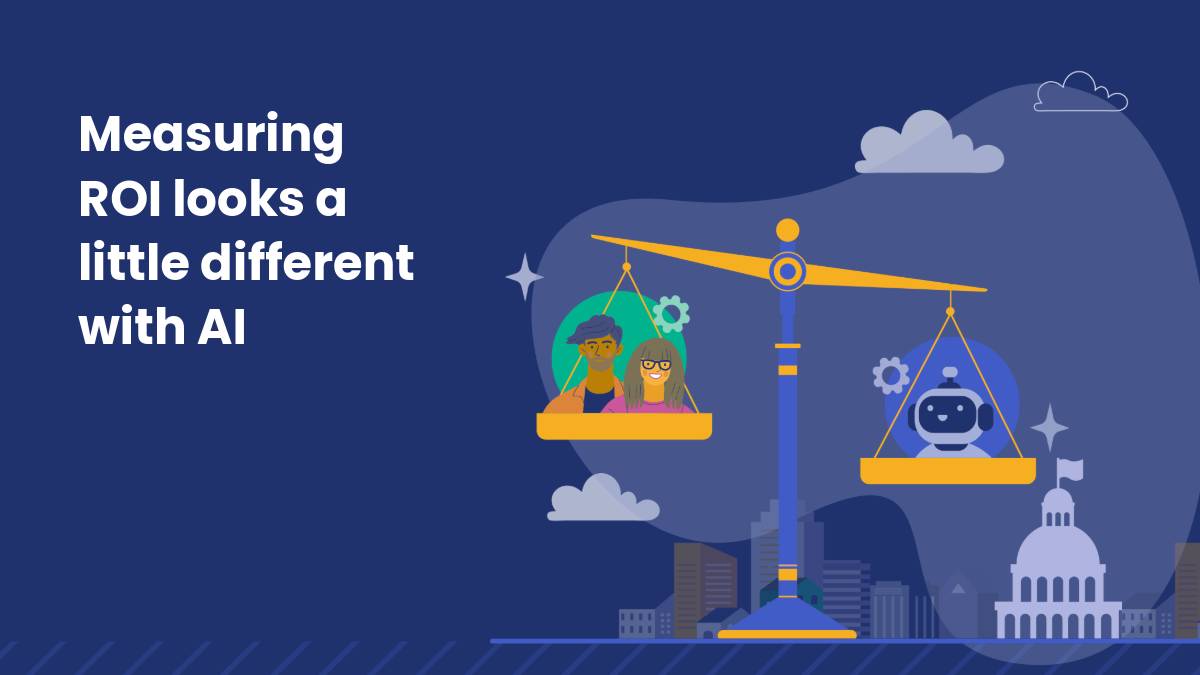


Artificial intelligence is quickly moving from experimentation to implementation across state and local government. Agencies are using AI to assist developers, automate document processing, improve compliance monitoring, and enhance resident engagement.
How do you measure the return on investment (ROI) of AI deployments in government?
Unlike traditional software that replaces a defined task or automates a specific workflow, AI reshapes how work happens. It assists staff, accelerates decision-making, and influences progress across teams, sometimes in ways that are difficult to quantify.
That complexity is reflected in broader market data: A Deloitte study found that only 10% of surveyed organizations report realizing significant ROI from AI. Half expect returns within three years, while another third anticipate a three- to five-year timeline. This isn’t because AI doesn’t have an impact on operations; success with AI requires clean data, planning, resource investment, and significant organizational change.
To build a case for AI investment, agencies need a nuanced framework — one that blends tangible financial metrics with operational and experiential outcomes.
Challenges of measuring the ROI of AI in government technology
One of the most common challenges agencies face is determining AI’s tangible impact on productivity. AI rarely delivers value in isolation — it’s introduced alongside broader modernization efforts, such as improving digital services, upgrading infrastructure, or streamlining reconciliation.
For example, if an AI assistant helps developers write code faster or identify bugs earlier, what is the precise value of that acceleration? Did the team ship more updates? Did error rates decline? Even if productivity improves, it can be difficult to isolate how much of that improvement is directly attributable to AI versus any other process or staff changes.
This requires a shift in thinking about ROI; although data is preferred, IT leaders should also consider what has changed in the agency (or on the team) post-AI deployment.
Establish baselines before deployment
To accurately measure AI ROI in the public sector, agencies should establish a documented performance baseline that includes:
- Average cycle time per transaction
- Cost per transaction
- Staff hours per task
- Error or rework rates
- Backlog volume
- Overtime costs
- Resident satisfaction scores
- Call center escalation volume
Not always neat numbers
Public and private sector ROI rely on clear financial outcomes. AI challenges that model because not every benefit fits cleanly into a spreadsheet.
Tangible outcomes still matter deeply in budget discussions: labor cost savings, reduced overtime, faster processing times, improved compliance, and measurable operational efficiencies. But government agencies must recognize intangible value. Higher resident satisfaction, clearer communication, improved transparency, and stronger trust are meaningful outcomes in government.
Avoided risk can also be considered an intangible part of ROI. If AI reduces compliance errors, prevents improper payments, or flags documentation gaps before audit, the value may not show up as new revenue, but it does prevent downstream consequences — things that should be accounted for even if it doesn’t immediately translate directly into revenue.
A practical framework for measuring AI ROI in the public sector
In government, AI return on investment must be evaluated across three areas.
Operational efficiency metrics
These are the most visible and budget-aligned indicators of AI value:
- Processing time reduction
- Reduced overtime
- Lower cost per transaction
- Backlog reduction
- Staff time redirected to higher-value work
Performance and quality improvements
AI can deliver value through improved accuracy and consistency:
- Reduced error rates
- Improved compliance
- Fewer audit findings
- Reduced rework or appeals
- More consistent case outcomes
Resident experience and public value outcomes
AI ROI extends beyond cost savings, especially in the public sector. It includes things like:
- Higher resident satisfaction
- Improved digital completion rates
- Fewer status inquiries
- Reduced confusion or complaints
- Improved employee engagement
AI that improves clarity, responsiveness, and fairness strengthens public confidence — an outcome that may not immediately appear on a balance sheet but affects agency credibility.
AI cannot fix a broken process
If underlying processes are inefficient, AI can amplify flawed workflows or systems. If data is incomplete or inaccurate, those weaknesses will be embedded into models and scaled, and predictive systems trained on flawed datasets can propagate bad decisions at speed.
Before measuring ROI, agencies must ensure that core processes are documented, data is reliable, and governance structures are clear.
Measuring ROI looks a little different with AI
Measuring ROI from AI in state and local government requires a new framework. The most effective leaders will balance model performance and what’s changed in the organization after deployment. Did processes move faster? Did error rates decline? Did residents experience fewer frustrations? Did staff spend more time on meaningful work?
Measuring ROI from AI in state and local government is less about proving that a tool replaced a job and more about demonstrating measurable mission impact.
Looking for more content?
Get articles and insights from our monthly newsletter.