Govtech shifts: NASCIO’s 2026 CIO Top 10 Priorities
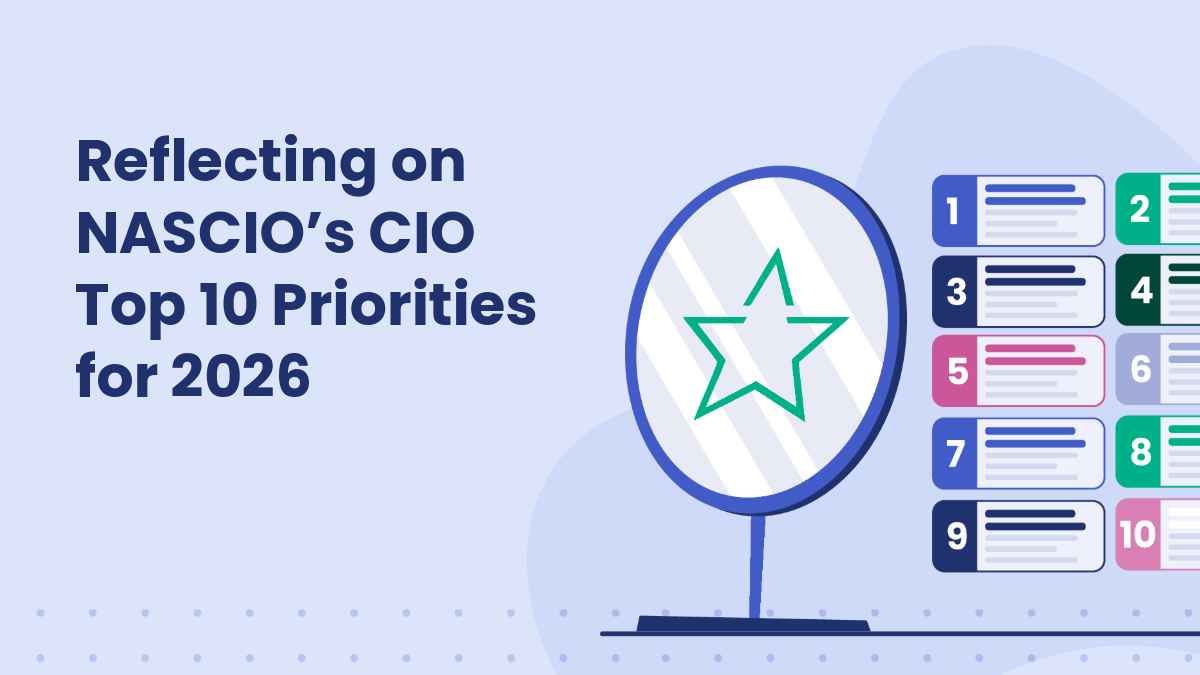


For two decades, the National Association of State Chief Information Officers (NASCIO) has released its annual State CIO Top Ten Policy and Technology Priorities. The report, based on responses from state and territory CIOs, helps inform both tech vendors and industry professionals.
Like many of you, we’ve been waiting for the 2026 results. As it turns out, the NASCIO’s CIO Top 10 Priorities mirror our team’s 2026 government technology predictions.
Weighing in on the NASCIO CIO Top 10 Priorities for 2026
NASCIO surveyed 51 state and territory CIOs to identify top policy and technology issues facing state government. Many of our in-house experts pinpointed these same priorities — ethical and practical uses of AI, stringent cybersecurity, efficiency, and effective modernization overall — as trends for 2026:
1. AI continues to rule the discourse around public sector digital transformation
Artificial intelligence (AI) has taken the top spot for the first time, moving up from second spot in 2025 and third spot in 2024. We’ve dubbed 2025 the year of AI hype — and predicted 2026 will mark a new era of thoughtful, ethical AI use (not just pie in the sky possibilities).
The NASCIO Top 10 respondents also gravitated more toward practical AI uses, highlighting governance, functional use cases, and the ethical use of AI as priorities for 2026.
Security and adoption are both listed specifically in NASCIO’s AI bucket. For us, that looks like:
- Cautious clients: Agencies are being very careful with their AI deployments
- A resident trust gap: Ethical governance of AI will be as important as the tech itself
- Keeping an eye on laws: IT leaders are keeping an eye on the evolving AI legislative landscape at the state and federal levels
Evidenced by taking the top spot on NASCIO’s 2026 Top 10 CIO Priorities, the interest in AI has only grown. However, in 2026, it will be used with intention, as a tool to achieve better outcomes in agency efficiency, customer service, and digital service delivery.
2. Cybersecurity goes hand-in-hand with more AI deployments and modernization
Although AI may be the buzz of 2026, cybersecurity remains a core (and incredibly intertwined) challenge for government agencies. Without strict security frameworks and data protection:
- Agencies can’t safely deploy AI tools or other modern technologies
- Residents will lose trust in their public leaders and government agencies
Cybersecurity remains in the top two CIO Priorities because every other aspect of digital transformation relies on a secure experience. Resident adoption and engagement, safe transactions, efficient reconciliation, and successful AI integrations can only happen with stringent security practices. Cybersecurity is critical for modernization.
3. Government leaders are doing a constant dance with budget constraints and financial management
When it comes to managing funding, 2025 has been tricky, and it seems like CIOs are expecting similar challenges and uncertainties in 2026 — budget concerns have jumped up three spots on the list (from spot six in 2025 to third in 2026). So the question remains: How can agencies accelerate digital service delivery while managing a budget reduction?
As confusion around budgets persists, efficiency continues to be the name of the game. Along with creative financial planning, project adjustments, and core service prioritization, efficiency-enhancing technologies (including AI tools) will be part of the puzzle. We’re expecting to see agencies lean into government technology as a way to create more sustainable processes without cutting frontline services.
4. Modernization is a broad-stroke priority, but efforts are specific to the community’s needs
Modernization is back in the number four spot for NASCIO’s 2026 Top 10 CIO Priorities (up from the fifth spot in 2025). Modernization as a priority is a little more difficult to quantify. It’s not one shiny new tool or a set of compliance rules. Updating legacy technology is a general framework, but each agency will have a different path on that journey.
As experts at PayIt put it: Agencies will need to identify their unique pain points and invest in solutions that make it easier for their community to access government services. That could be connecting systems that have been operating in silos, accessibility improvements, or making internal process improvements.
Other interesting moves on NASCIO’s 2026 Top 10 CIO Priorities
- Accessibility moves up several spots. Last year was the first time that accessibility even made the list, landing at number 10. For 2026, accessibility leapt up four spots to the sixth top priority for CIOs. This is vital as agencies look to better serve their communities.
- Consolidation makes an appearance. Centralizing and optimizing services is back on the list — something that has been driving our clients’ digital transformation projects as well.
- Workforce has fallen off. After falling a few spots from 2024 to 2025, knowledge and skills training seems to be less of a concern going into 2026.
The public sector has big goals despite uncertainties, favoring adaptable teams
Last year, we expected agencies to strike a balance between technical agility, data security, and the consumer experience, with challenges related to new technology. In 2026, those challenges remain, but modernization will require more rapid changes and cost-efficient tools and practices.
Finding ways to use AI wisely, enhance cybersecurity, and engage residents — all on a strict budget — will require a nimble staff who can adapt in the face of challenges.
Looking for more content?
Get articles and insights from our monthly newsletter.