2026 government technology trend predictions


2025 was the year of AI hype in the public sector. However, as we approach 2026, government agencies are shifting from overly excited to more realistic, smarter AI strategies — with a greater focus on measurable outcomes, efficiency, and trust.
Government technology trends we’re expecting for 2026
What are we expecting? Overall, it seems like the mood will be less “shiny new tool” and more purposeful AI integrations into existing processes (like data governance and compliance workflows). That shift will still require careful change management practices, proactive resident engagement, and honest assessments of the gap between an agency’s current tech stack and its modernization goals.
Our in-house experts predict that these government technology trends are likely to prevail in 2026:
Thoughtful AI deployments
Widespread AI enthusiasm isn’t going to die out next year, but in 2026, we expect to see a correction of sorts. Budgeting resources for “AI innovation” won’t be enough.
AI as a mark of efficiency

There’s an expectation of a better digital experience, but that’s challenged by tighter budgets all the time at city, county, state, and provincial governments. In all these departments, they have to do more with less. It isn’t AI for AI’s sake. To accelerate the mission around digital service delivery, many modern platforms will be designed with AI embedded in the solution.
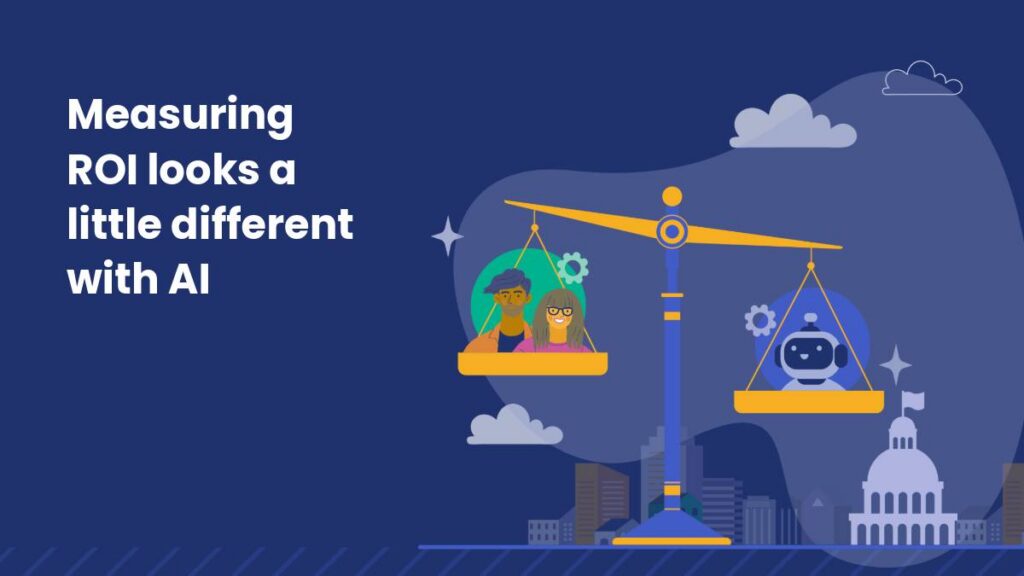
AI will be used intentionally to achieve better outcomes in areas such as efficiency, reconciliation, transaction volume, interaction quality, or customer service — empowering people, not replacing staff.
AI-assisted automation — specifically, tools that simplify routine tasks like form processing, customer service triage, and data validation — will help free up staff to focus on higher-value, resident-facing work.
In 2026, AI will continue to redefine the public sector workforce, but probably in a way that’s less exciting — think integration into existing workflows, data governance and hygiene, and regulatory compliance.
AI is a tool to solve a problem, and you can use it very well if there’s a good use case for it. But AI became a buzzword so rapidly, and people were signing up for every company that had AI — something that was unique but was possibly preemptive. We’re likely to see a correction in 2026, maybe into 2027. It’ll be interesting to see how the AI industry evolves over the next year or two.
Experts at Forrester agree: There has been a disconnect between the inflated promises of AI vendors and the value created, which will likely result in a market correction. More emphasis will be put on functionality (rather than hype).
Trust becomes a defining aspect of AI integrations
The AI trust gap is one of the biggest tech-related challenges governments will face in 2026. As AI tools become more common in government, the challenge won’t just be adopting them; it’ll be ensuring transparency, fairness, and resident trust in how they’re used. Ethical governance of AI will become as important as the tech itself.
In 2026, trust and innovation will be one and the same: privacy, data security, and AI governance will be critical for modernization.
So far, our clients are taking a very cautious approach to AI. Everybody wants to use it, but they’re communicating to us that they’re being very cautious about the areas where they implement it. We’ve had a few clients ask us to notify them how we’re using AI because they want to maintain control over that.
Additionally, there are a bunch of states that are all passing laws around AI use, especially in regards to how AI is making decisions instead of humans.
Improved change management practices
Continuous transformation and change for your team members will be the status quo in 2026 — something that leaders will have to incorporate into their culture as usual and unintimidating.
The skill that I think will be the most important for public sector employees in the next year is change management — specifically, the ability to embrace new technology, which can be inherently disruptive to everyone. Having public sector employees adapt, communicate the transitions, and manage concerns around any resistance that’s coming up around new technologies, all those things I think are key.
Agencies that embrace formal (and positive) change management procedures will be more likely to get a better return on technology investments and have a better chance of keeping staff happy and confident in their roles.
Resident engagement to match modernization efforts
New shiny technology is nice, but your agency won’t see many benefits if people aren’t using it. We expect to see digital advances paired with bolstered resident engagement strategies.
I see agencies investing more time and resources into inclusive community engagement. It’s not enough to modernize services, but in my client conversations, agencies also want to ensure every resident can access [services] regardless of their language, their age, or comfort with technology. So I believe this focus will only grow stronger in 2026.
Similarly, our clients have been requesting bilingual materials. (Right now, it’s English and Spanish.) And we are tailoring the messaging: When a new platform is introduced, we really try to hone in on the language that we use.
Avoiding one-size-fits-all approaches to modernization
In the public sector, there isn’t one problem to solve; each agency has its own unique pain points.
Agencies are going to invest in whatever is going to make providing government services easier. Every client is different, and each one is going to have their own set of challenges.
Communication and connectivity will both be major themes of modernization efforts in 2026.
Governments are realizing that modernization isn’t about buying new tools; it’s about making existing ones work together. Connecting systems that have been operating in silos for decades, adaptability, data literacy, and communication (employees who can translate between technology, policy, and people) will be the MVPs of modernization. The future belongs to those who can learn fast and collaborate across disciplines.
A team that relishes real-time adjustments will fare better in 2026
The ability to adapt to disruption will be an asset in 2026. It’s likely that public sector teams will need to find success amidst uncertainty, whether that involves budgets, technology, or staffing.
I don’t think the skills that will be the most important for public sector staff in 2026 are much different than the skills that were needed in 2025 or at any point in time in humanity.
AI is an exciting frontier, and it will open new possibilities for how government delivers services, but how do we get to that frontier and thrive once we are there? That’s through adaptability.
Adaptability is the most important skill that any person can build. And if you have that, whether you work in the public sector or you work in the private sector, you’ll be well-suited for whatever tomorrow throws at you. We all know that the challenges we’re going to face tomorrow are going to be different than the challenges we’ve faced today.
Being adaptable is how we put ourselves in the position to meet and solve new challenges.
Finding new, ethical ways to use AI, enhance cybersecurity measures, and engage residents will be less about concrete predictions and more about nimble staff who can make quick adjustments.
Looking for more content?
Get articles and insights from our monthly newsletter.