How government payments technology reduces delays


From a resident’s perspective, government transactions look straightforward: renew a license, pay a bill, request a record, update an address, or apply for a permit. They click a button and expect the process to move forward.
Behind the scenes, that same transaction can touch multiple teams, systems, and vendors. When any part of that process breaks down, the resident experiences it as a delay or a confusing status update — or, even worse, they might have to travel to the office to complete their task.
This gap between what residents see and what government staff manage day to day creates operational strain and can frustrate customers. Here are a few common bottlenecks for public sector staff and how modern technology can help mitigate them:
1. Legacy systems and disconnected workflows create invisible delays
The Government Accountability Office recently highlighted the burden and risk of legacy IT, including outdated technologies and systems that are difficult to modernize. Yet many agencies still rely on older systems that weren’t designed to share data easily or to display real-time status across departments. When systems don’t talk to each other, staff end up doing more manual work: re-entering information, checking multiple screens, and reconciling records.
Using outdated technology causes issues like:
- A resident uploads a document, but staff must download it, rename it, and attach it somewhere else
- Status updates depend on a person remembering to move a record to the next step
Residents, however, increasingly expect the same clarity they get from modern online services, like confirmation emails, progress updates, and predictable timelines.
2. Paused or delayed funding can stall work in ways residents can’t predict
Even the best teams can get stuck when funding changes, interrupting work with vendors, contractors, or temporary support staff. In periods of uncertainty, agencies and contractors deal with delayed payments and project pauses.
Delays result in things like:
- A call center contract can’t be extended on time, and response times spike
- Technology implementation slows because a planned phase is paused
- Support is reduced, and backlogs grow quietly until they become visible
Residents usually aren’t privy to the why, they just feel the outcome: longer wait times to complete necessary tasks.
3. Burnout and understaffing take a toll
When teams are understaffed, every exception becomes a time suck: a missing document, a name mismatch, or a system bug. Over time, these smaller issues compound — possibly leading to a lengthy backlog and tech debt.
Error rates and rework are a credibility risk
When an agency has to correct errors, reverse decisions, or reissue documents, the impact isn’t only operational. Overworked teams are more likely to experience higher error rates, longer lines, and reprioritized projects. It frustrates residents and may lead to agency scrutiny. Even when the issue is process complexity, residents often interpret errors as carelessness.
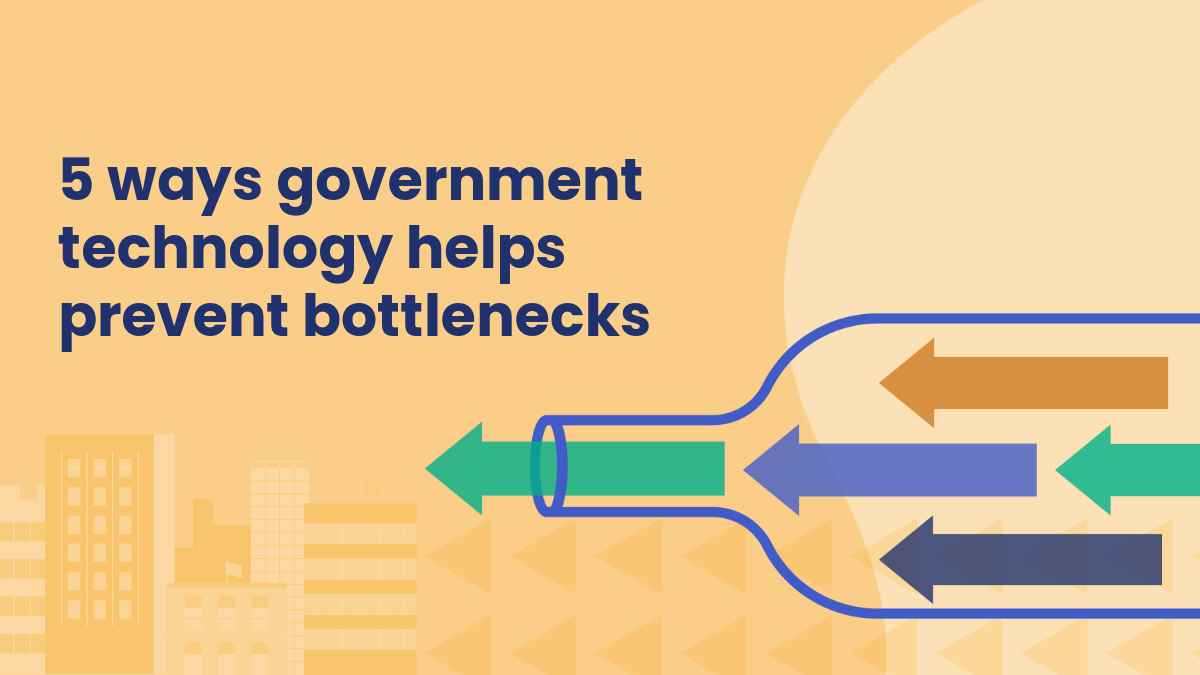
How modern government technology helps prevent bottlenecks before residents feel them
Technology plays a critical role in whether small inefficiencies stay small or compound into service delays. Modern government platforms can reduce friction across the entire transaction lifecycle — saving your team time and hassle.
Unified systems reduce rework and manual handoffs
Modern government payment solutions prioritize integration and shared data models. Your team benefits:
- Payment details automatically update
- Document uploads are linked directly to the relevant transaction
- Status changes trigger updates across systems in real time
Built-in validation prevents other errors
Many delays begin at submission: incomplete forms, mismatched fields, incorrect documentation. But modern digital workflows validate required fields before submission and flag inconsistencies in real time, freeing staff time for higher-value work (instead of reprocessing avoidable mistakes).
Real-time tracking improves transparency for staff and residents
One of the most common sources of frustration, for both residents and employees, is the lack of visibility into status. Modern tools offer real-time dashboards for operational leaders and resident-facing status updates — improving employee satisfaction and resident trust simultaneously.
Automation can reduce burnout
Automated receipt confirmations, standard approval or denial templates, and payment confirmations and reminders help reduce repetitive administrative tasks that contribute to fatigue and errors. Staff can focus on exceptions, complex cases, and resident support instead of transactional overhead.
Scalability absorbs seasonal spikes
Cloud-based, scalable platforms are designed to manage volume spikes without performance loss. Digital government solutions can provide faster processing during peak cycles and stable performance even under heavy load.
Government payments technology is good for public sector teams and the community
For residents, a transaction should feel simple. With the right technology in place, teams can reduce rework, prevent delays, and deliver the kind of clear, predictable experience the residents expect.
You might also like

Useful GovTech insights — right in your inbox
Get articles and insights from our monthly newsletter.