Government payments platform vs. merchant processor


For many public sector leaders, improving how residents interact with government services starts with “we need online payments” without realizing that this framing can limit outcomes and often creates more problems than it solves.
Payments in government aren’t just transactions; they’re part of a larger service journey. Residents log on to complete necessary tasks: pay taxes, renew a license, register a vehicle, resolve a citation, or secure a permit. If any part of that experience fails, people get frustrated.
Before agencies ask for a payment processor, they need to understand the distinction between money movement and service completion.
What does a merchant processor do?
A traditional merchant processor handles card and ACH transactions: routes funds, authorizes payments, and settles them into the government’s bank account. Merchant processors act as middlemen, moving transaction data between the customer’s bank and the agency’s bank — it’s necessary, but that’s only one piece of the puzzle.
Although merchant processors manage transaction authorization, money movement, and settlement of funds, they don’t provide:
- A front-end resident experience
- Workflow continuity across services
- Integrated resident identity
- Adoption or user support outcomes
- Real-time back-office visibility
When agencies focus on just the basic criteria, they end up getting financial plumbing with no service delivery — making it more likely residents will still struggle to complete services.
Why payments alone are the wrong starting point
Many government agencies evolved their technology in silos, and payments were often added onto these disparate legacy systems. The result is a fragmented experience: separate logins, inconsistent data, and different support channels for transactions and service issues.
This fragmentation has real consequences:
- Residents cannot easily complete cross-agency services in one session
- Support calls fall on the agency instead of the vendor
- Staff must reconcile multiple reports and tools manually
- The resident journey is confusing (and frustrating)
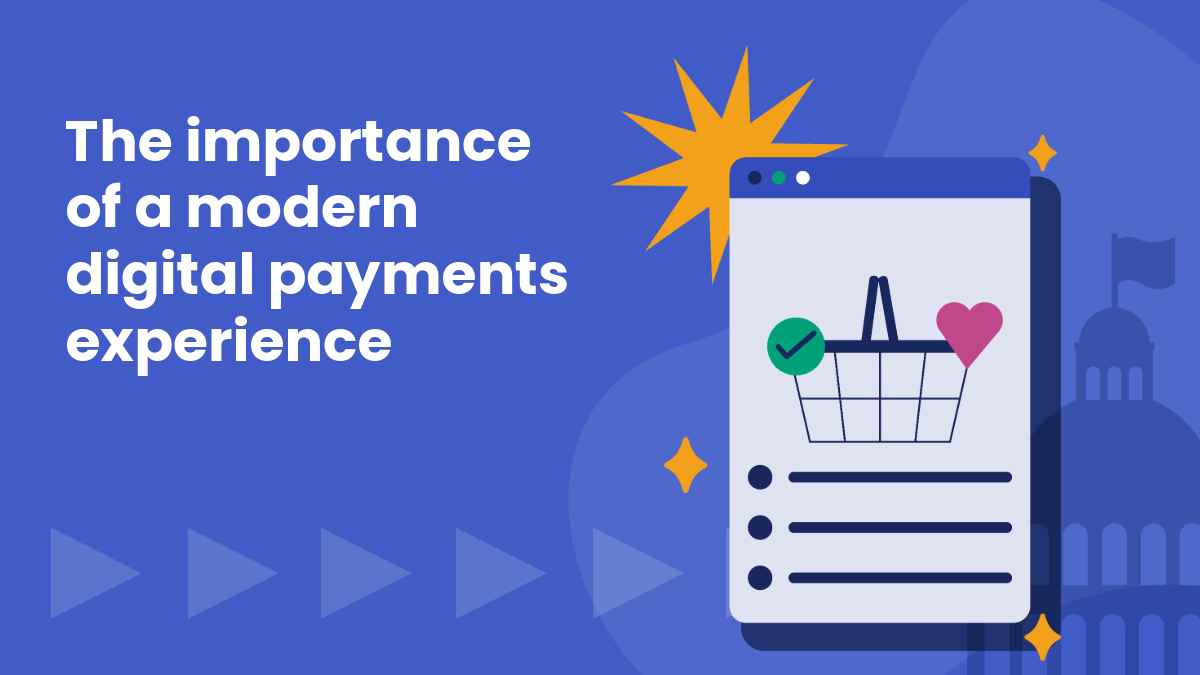
Overview of a modern digital payments experience
Residents expect experiences that mirror the private sector, which means more streamlined interactions and modern digital features. A modern payments solution provides more than transactions:
1. A full, intuitive resident experience
Government payments are among the most common digital interactions residents have with agencies. When designed well, they contribute to trust, transparency, and satisfaction — not just revenue collection. Integrated digital interfaces that let residents move from forms to payments to confirmations without context switching help reduce abandonment and frustration.
2. A platform, not a point solution
Payment systems that integrate billing, reconciliation, reporting, and identity are more effective than standalone consoles. This is because they:
- Provide centralized dashboards for staff
- Reduce manual reconciliation errors
- Offer resident history and receipts in one place
- Enable cross-department data insights
A unified platform becomes a single source of truth, eliminating fractured workflows.
3. A solution designed specifically for government use
Unlike merchant processors built for broad commercial use, government-oriented solutions take into account:
- PCI and other public sector compliance requirements
- Diverse revenue types (licensing, fines, taxes, permits)
- Multi-channel collection (web, mobile, in-person, kiosks)
- Accessibility requirements across populations
A purpose-built platform doesn’t just accept payments; it ensures that those payments are part of a broad, secure, and accessible service experience.
Operational benefits for agencies
If you reframe payments as an integral part of service delivery, there’s measurable value for agencies:
- Faster, more accurate reconciliation: Modern platforms can condense hours of manual work into minutes and reduce human error.
- Real-time financial visibility: Rather than reconciling multiple, disparate spreadsheets, agencies can access dashboards that show collections and revenue across services.
- More support and better adoption: Agencies see better adoption when residents find online options convenient and intuitive. And when residents do struggle, support isn’t a generic ticket number to a call center; it’s tied to the same vendor that manages the resident experience solution.
- Reduced administrative burden: A unified system can minimize siloed procurement and maintenance of multiple tools, improving transparency and resource allocation.
Why government agencies need a strategic payment partner
Government buyers often seek the cheapest merchant processor or the lowest cost per transaction. But that question alone misses what agencies actually need: a strategic partner that helps government serve residents better, reduce internal friction, and modernize the entire service experience.
Instead of asking, “Who can process payments?” agencies should ask:
- How will this technology integrate with identity, workflows, and services?
- What role does the vendor play in adoption and support?
- How does the system improve back-office efficiency and reconciliation?
- Can residents complete complex service flows with minimal friction?
These questions help reframe procurement to enable agencies to make a strategic investment in digital government services.
Moving beyond merchant processors
Although a merchant processor may solve the narrow need of card acceptance, agencies that settle for just transactions won’t improve adoption or operational efficiency. By moving toward unified, resident-centered payment experiences, agencies can meet rising expectations, support staff, and truly modernize government services.
You might also like
Useful GovTech insights — right in your inbox
Get articles and insights from our monthly newsletter.