
- Success Story
Smart Guide, an AI discovery
solution, is changing
government service delivery
Across the country, state and local government agencies are pursuing responsible AI deployments to help modernize digital services. Along with pushing to meet efficiency goals, public sector leaders are investing in AI solutions to improve service and resident satisfaction.
Service discovery is a bottleneck that AI can solve
As agencies expand digital offerings, service catalogs grow rapidly: utilities, property tax, permits, licenses, citations, events, and other specialty services — all consolidated into one portal. Consolidation improves service access, but the variety of options can be overwhelming for residents.
They’re scrolling and clicking, and sometimes residents aren’t even sure what they should be looking for. This is the type of problem that’s perfectly suited for introducing a fast, targeted intelligent search tool.
Smart Guide bridges the gap between how residents talk and government websites read
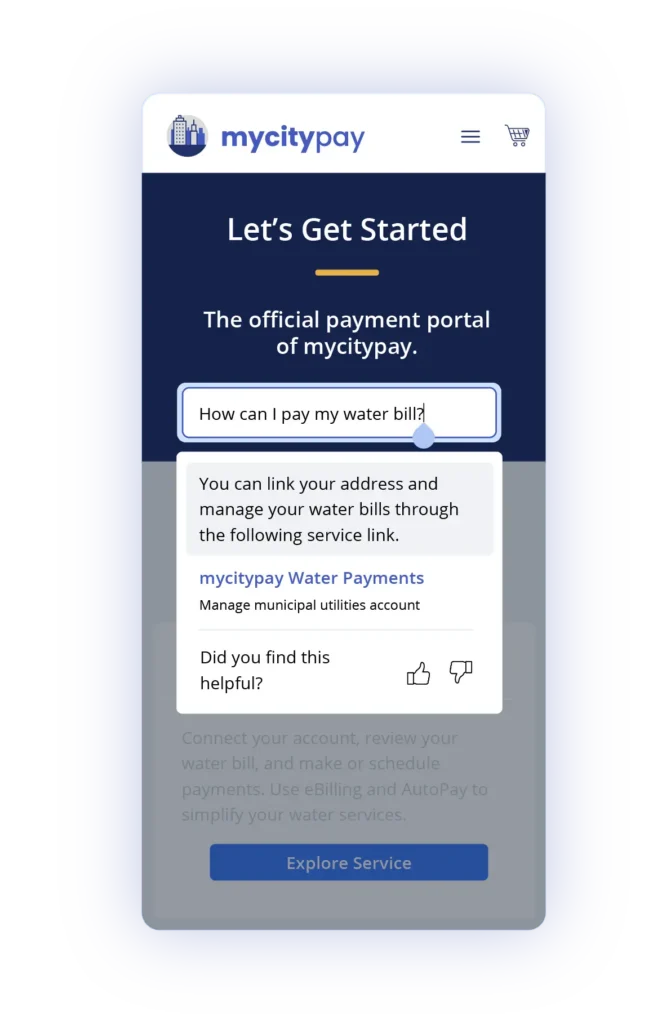
Smart Guide is a task-focused AI discovery tool built into PayIt’s resident experience platform. Residents can type a natural-language request, such as “Pay water bill” or “Do I need a sewer permit?” and immediately get a link to the correct service or form.
Embedded within PayIt’s resident experience platform, Smart Guide helps people find exactly what they need using natural-language requests, guiding residents to the right services across the government website without requiring them to navigate complex menus, reducing friction, increasing digital service usage, and lowering support inquiries.
Removing barriers in discovery
Instead of calling the support line or visiting the office, residents are able to search in layman’s terms and ask common questions:
- Pay property tax
- Renew my driver’s license
- Delinquent real estate tax
- Where’s the medical examiner’s office?
For residents, that means getting more helpful results that match intent to needs.
Residents gain confidence from approved information sources
Smart Guide functions as a governed discovery layer designed to increase completion and reduce support demand. Unlike open-ended chatbots, Smart Guide:
- References only approved service content
- Does not pull from the open internet
- Provides direct links, not long conversations
- Provides useful data on what residents are searching for
Trust in government is critical, so Smart Guide only uses authoritative, approved sources.
Early adopters are already getting positive outcomes
Early adopters of Smart Guide AI discovery — including Anoka County, Minnesota; the City of Lansing, Michigan; and the City of Grand Rapids, Michigan — are proving that when AI is applied narrowly, responsibly, and with measurable intent, governments achieve immediate benefits.
Their results demonstrate that AI delivers value in government when it is practical, governed, and tied directly to service completion.
Anoka County, Minnesota
Anoka County was among the first to deploy Smart Guide AI discovery across a multi-service platform. In just a couple of months, Anoka reports:
- 30% reduction in support volume since launch
- 20% of new service traffic has been driven by Smart Guide AI discovery
One surprising insight
A large percentage of residents searched for services already on the page rather than scrolling below the fold to find them; they used Smart Guide, and the AI tool routed them instantly.
This isn’t a navigation failure; it’s a behavioral preference, highlighting how intelligent search can accelerate service access, even for services technically on the page.
City of Lansing, Michigan
Smart Guide is helping Lansing make big improvements: Residents have already taken advantage of the new search option, and previously hard-to-discover workflows are now receiving steady traffic without additional marketing or outreach.
In just the first weeks:
- Hundreds of residents used Smart Guide, and many of them made payments through the AI-guided suggestions
- Nearly 50% of people who used Smart Guide ended up on a service page, showing how quickly it helps residents find what they need
Lansing’s service structure includes nested departments and branch-based workflows. Previously, residents had to:
- Select the correct department
- Choose the correct branch
- Locate the appropriate workflow
Now, residents can simply type:
- “Sewer permit”
- “State financial assistance”
AI routes residents directly to the correct service or form, helping surface underutilized digital services.
City of Grand Rapids, Michigan
Grand Rapids quickly realized that Smart Guide was more than a front-end feature — it’s also a source of insight. Search logs reveal how residents described their needs, often differently from how agencies labeled services.
Their data exposed:
- Opportunities to clarify service language
- Confusion around delinquent tax workflows
- Content gaps affecting conversion
Instead of guessing about improvements, the city used real resident language to refine its digital experience. For Grand Rapids, AI became both a routing tool and a feedback loop that leads directly to user experience improvements.
AI search has eased web navigation and access to government services
This change is already showing up in how people use the site. About 1 in 5 visitors now start by typing what they need, instead of clicking through menus.
Across early deployments, approximately 80% of Smart Guide engagement has been directed toward long-tail services — lower-volume offerings typically located below the fold. Historically, these services required:
- Targeted marketing
- Direct staff assistance
- Or in-person visits
AI-driven search changed that equation. By enabling natural-language discovery, agencies broadened equitable access across the full service catalog, not just high-visibility services like utilities and property taxes. This is a meaningful shift in digital inclusion.
A smart way to use AI
Anoka County, Lansing, and Grand Rapids are demonstrating that when tightly scoped and well governed, AI solutions like Smart Guide make an immediate positive impact for government agencies:
- Reduced support burden
- Increased digital adoption
- Greater use of long-tail services
- Clear insight into resident intent
These agencies did not deploy open-ended, internet-trained chatbots. Instead, they implemented AI built on disciplined guardrails:
- AI references only official agency content, never the open internet
- Residents receive concise guidance and direct links, not long conversational threads
Keeping pace with evolving resident expectations for digital services
The results these agencies are reporting, even mere months after launching, reflect a broader shift in expectations. Residents no longer want to navigate government by department structure or sift through complicated websites. They expect to type what they need and receive instant guidance. Agencies that meet that expectation get fewer support calls, faster task completion, and stronger engagement across digital services.